Webpage checker · hotnewsinternational.com
AI implementation budgets: operating strategy and page analysis
Visit hotnewsinternational.comRead the original long read ↗
How a technology budget becomes a controlled portfolio of workflows, experiments and measured outcomes.
Live HTML checked 16 October 2026 · HTTP 200 · English long read
HTML inspection
Page characteristics
Observed from the fetched public HTML. Counts cover the whole document unless labelled otherwise; article word count includes text within the first article element. These are page characteristics, not a ranking or performance score.
| HTTP status | 200 |
|---|---|
| Final response URL | https://hotnewsinternational.com/posts/russia-ai-strategy-gap-2025/ |
| Title tag | AI Budgets Need a Business Strategy · Hot News International |
| Title length | 60 characters |
| Meta description | A survey of more than 700 companies exposed the gap between AI budgets and the operating architecture needed to turn pilots into controlled business value. |
| Description length | 155 characters |
| HTML language | en |
| Canonical URL | https://hotnewsinternational.com/posts/russia-ai-strategy-gap-2025/ |
| Meta robots | Not declared |
| Viewport | width=device-width, initial-scale=1 |
| Heading counts | H1: 1 · H2: 22 · H3: 10 · H4: 0 · H5: 0 · H6: 0 |
| H1 text | AI Budgets Need a Business Strategy |
| Article element word count | 2,058 words |
| Whole-page image elements | 28 |
| Images with non-empty alt text | 26 |
| Whole-page links | 54 |
| External link elements | 14 |
| Response HTML size | 34,209 bytes (UTF-8 snapshot) |

Article overview
Allocating money to artificial intelligence does not establish what the technology should change. Hot News International examines that gap through a late-2025 survey account and a wider framework for implementation. The source reports that 26% of surveyed organisations budgeting for AI said they had an implementation strategy. The denominator is those budget holders within the study, not every company in the economy. Self-reported strategy also does not independently establish its quality or the outcome of any application.
Pilots remain legitimate when they answer a defined question. The article distinguishes a bounded experiment with a baseline, owner and decision gate from a demonstration maintained indefinitely without a path to production or closure. It also notes that company size did not form a simple maturity ladder in the survey. Possible explanations about complexity or available expertise are hypotheses, rather than causal findings supplied by the reported percentages. The useful question is how an organisation connects learning across initiatives.
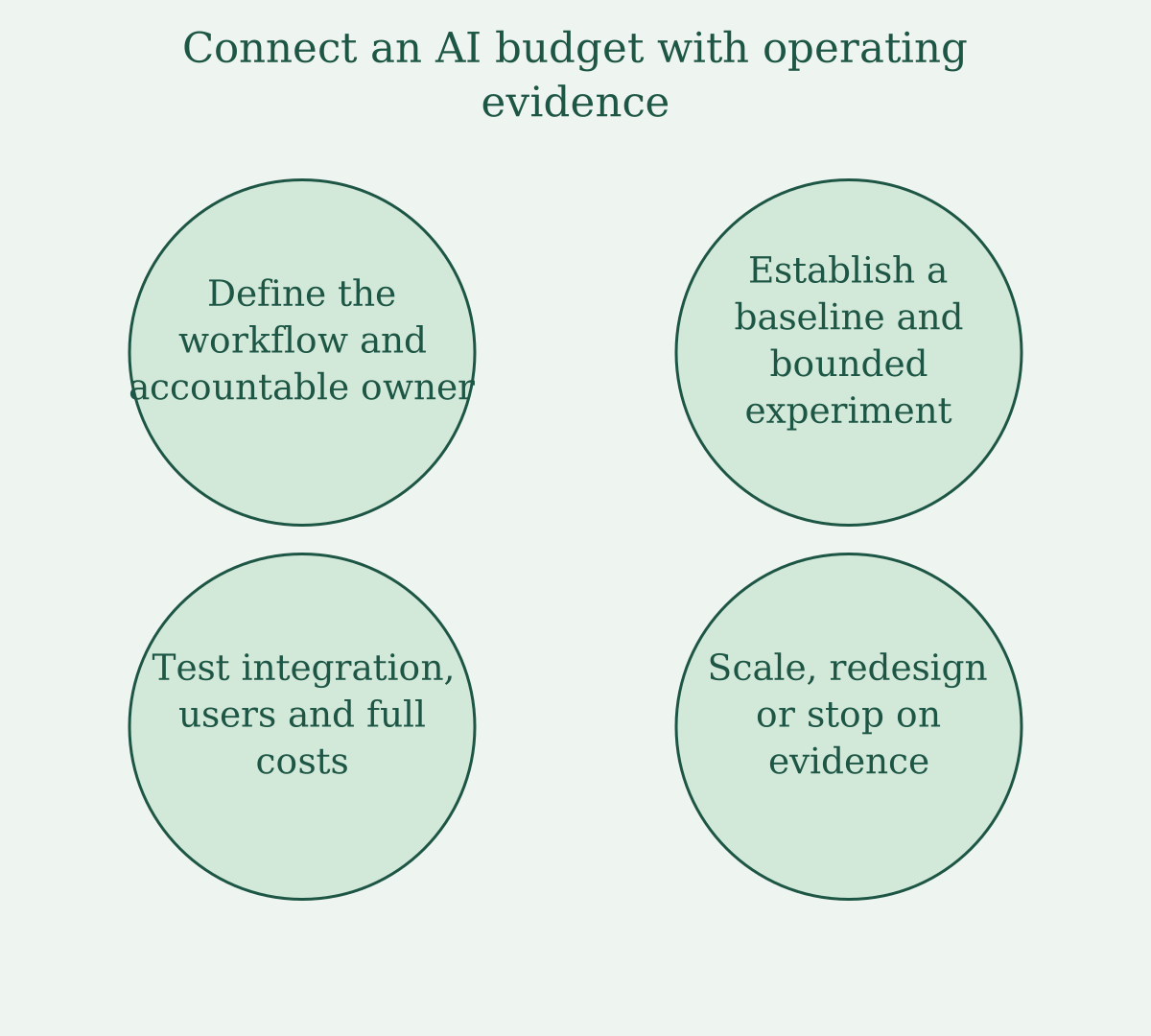
A workflow provides a more concrete starting point than the instruction to deploy a model. Teams need to identify inputs, actors, delays and the decision boundary before choosing a technology. Search, rules or process redesign may address the constraint more reliably. Where a model is appropriate, the benefit case needs data preparation, integration, review and continuing support costs alongside access fees. A strong technical metric remains an intermediate observation if employees cannot use the result productively.
Production requires an operating architecture. Identity, permissions, version control, evaluation and recovery arrangements turn a local demonstration into a service that can be sustained. Data ownership and meaning must be maintained by the relevant business functions, not assigned solely to a central technical team. The source recommends review proportionate to consequence and autonomy, with owners remaining responsible for outcomes after approval. A spelling assistant and a tool affecting a consequential decision do not create the same governance task.
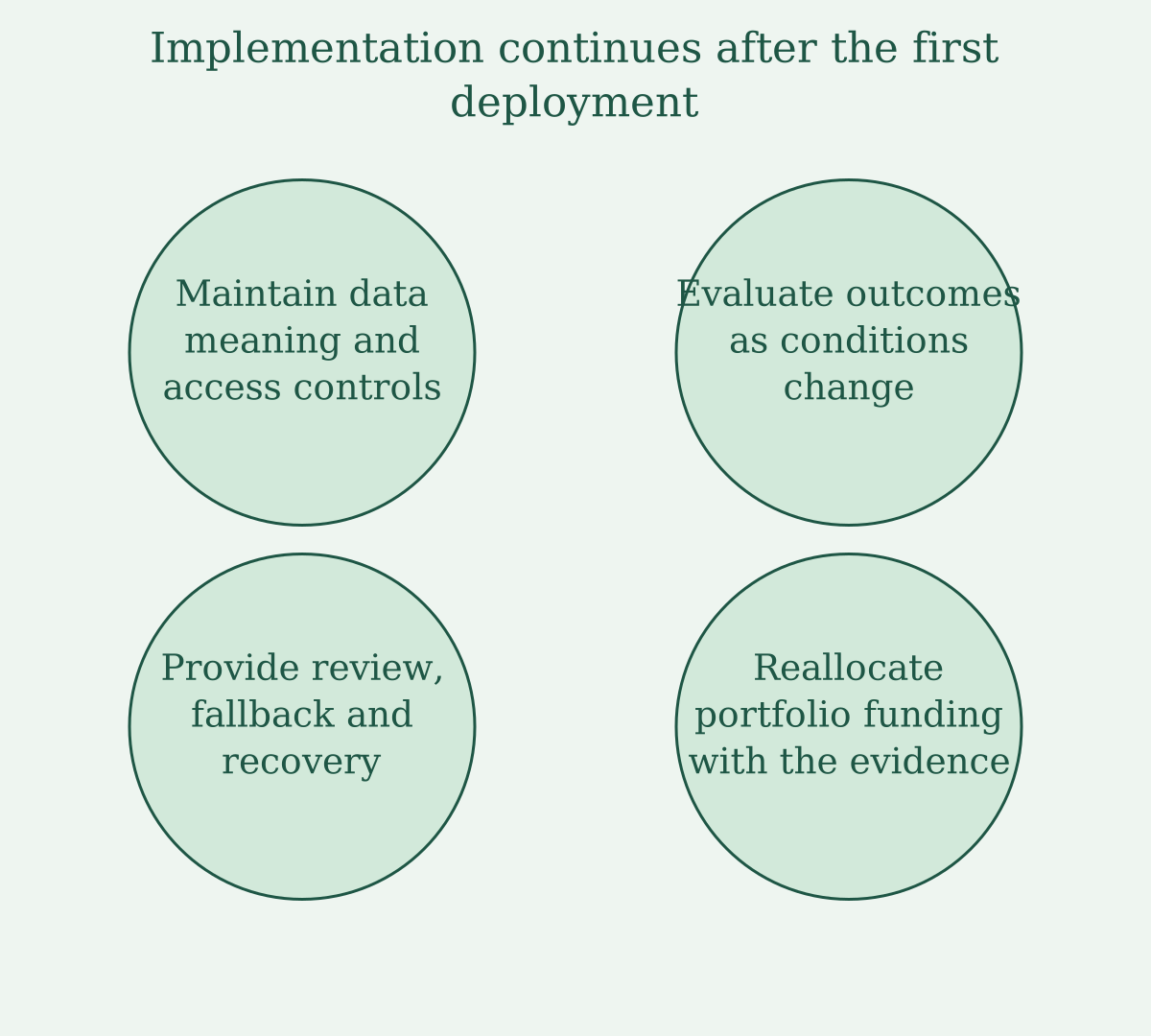
Adoption, monitoring and funding complete the loop. Released time becomes value only when work changes, and models need evaluation as users, vendors and inputs change. Portfolio funding should follow evidence, allowing an initiative to scale, be redesigned or stop. Shared infrastructure deserves support where reuse is demonstrated, while unsupported projects should not survive merely because they appeared in an annual budget. The long read’s central contribution is to treat AI strategy as business architecture: priorities, workflows, data, people and controls must connect with measured outcomes before spending becomes a repeatable capability.